

%402x.svg)
Features and innovations
Feb 2026

3 min.
Features and innovations
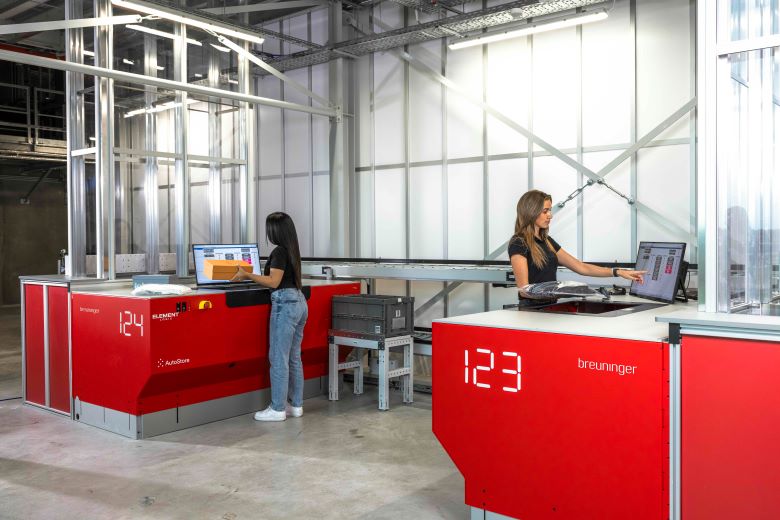
A traditional company that thinks like a modern tech company—that's the retailer Breuninger. Between shop windows, online stores, and smart warehouse logistics, it shows what innovation in retail really means: processes that think for themselves. And that's exactly what they do at the Sachsenheim Goods Service Center (WDZ), where an AutoStore system built by Element Logic has been in operation since the end of 2024 – controlled by our WCS SuPCIS-L8.
Just under a year later, Nicolas Fournier (Head of Product Fulfillment at Breuninger) and we take stock. In an interview, he explains how AutoStore and WCS have changed logistics processes and daily work.
"Our goal was clear: we wanted to increase e-commerce capacity, streamline processes, and consolidate all inventory in one location," says Fournier. Prior to the project, e-commerce goods were distributed across multiple locations. "That was not an ideal situation," explains Fournier. "We had to move goods back and forth. With the new AutoStore in Sachsenheim, everything is now centralized and processes have been accelerated. As part of the project, we expanded part of the hall, created additional capacity for shipping and goods dispatch, and freed up space for shelving systems."
Breuninger evaluated several providers. "All WCS systems offer the same basic processes: storage, picking, consolidation, and inventory," says Fournier. "But it was clear to us that our requirements went beyond that. We were looking for a WCS that could be individually expanded or customized. We also had a feeling that we would need special functions. And that's exactly how it turned out. Based on our experience with AutoStore projects, the existing modules, and the high software flexibility, we decided on this WCS," adds Fournier.
"We have a very wide range of products: fashion, beauty, home & living. That's why we wanted to store everything that fits in terms of volume in AutoStore, except for hazardous materials and products that are too fragile or sensitive," reports Fournier. "And because our goods in AutoStore consist of a wide variety of new goods and customer returns, it was clear that it would be a mixed storage solution."
"We knew it would be complicated," recalls Fournier. "We work with three different bin sizes—whole, half, and quarter compartments. Everything has to be prepared and available. SuPCIS-L8 made it easy to map this to the ports. We only had to adapt the GUIs slightly to our needs. We deliberately chose these three subdivisions and not more. This simplifies the processes, even though the beauty sector can sometimes be very fragmented."
When storing items, the WCS checks whether it makes sense to store them together. For example, identical items in different sizes but the same color may not be stored in the same compartment. This means that identical sweaters in size M are not stored directly next to those in size L. This prevents picking errors and reduces picking time, especially when order volumes are high.
At the same time, the WCS also keeps an eye on safety-related aspects. Hazardous material detection reports relevant items in good time. In the exceptional case that a hazardous material enters the AutoStore infeed due to a change in master data, the WCS immediately warns: "Attention, do not store." This ensures that the process remains safe and compliant, even in the event of unexpected data changes.
Fournier explains: "We need accurate weight information for our export processes. Originally, we weighed the goods centrally at a station in the warehouse. But that was inefficient and prone to errors in our sprawling warehouse. Containers were lost, there were repeated quantity discrepancies, and the goods in the process were not saleable during that time. There are also many unnecessary scanning points. So it quickly became clear that we wanted to weigh goods directly at the AutoStore port!"
What makes it special is that the weighing process runs independently of the picking process. It is a separate process with its own "movement type." This ensures that the process is clearly documented and traceable in the system.
A wide variety of goods flows converge at AutoStore. Some items have to be sorted into existing orders, while others go directly to the shipping station. Sometimes items from the store are needed and transferred to the goods service center (WDZ).
Whether weighing, express shipping, supplier returns, or sorting processes—Breuninger has defined its own movement types for these tasks, and the WCS recognizes them. This gives employees the ability to prioritize according to business needs and intelligently control this via the number of ports and employees.
"That was very valuable for us," emphasizes Fournier. "We wanted to control exactly what happens when—and we can do that perfectly with the movement types. If we need a new movement type, we define it and it is implemented for us. That gives us enormous responsiveness."
At Breuninger, orders are prioritized according to delivery promises, such as DHL Express. However, these orders are not processed in the general order pool, but are handled and tracked separately. This means that it is always clear how many express orders are still open and by when they must be dispatched in order to meet the delivery promise. "No black box and no system logic that we cannot understand," adds Fournier.
Breuninger can organize returns in batches according to supplier structures. This allows item lists to be processed efficiently and packed into a container. This saves time, reduces handling costs, and creates transparency for all parties involved.
Breuninger relies on clear processes for workplace management. Team leaders can see which orders are pending in the backlog in the system. They decide which ports are used for storage, picking, consolidation, or inventory. These can be adjusted at any time to respond flexibly.
The allocation creates a systemic inventory. If an item is missing during picking, the WCS automatically creates an inventory order for the bin or SKU. The bin in question is then returned to the port and checked. In addition, the WCS checks at specified times which containers have not yet been inventoried. An empty message is also considered an inventory result. Employees confirm whether the container is actually empty. Unlike traditional inventories, Breuninger does not work with target quantities. Instead, the company uses blind scans. Employees do not see an expected quantity. They simply scan what is available. This allows stocks to be reconciled directly in the system.
One year after launch, one thing is clear: the decision was the right one. "Our inventory in AutoStore is more accurate than in a shelving system. Errors occur more frequently there. Employees scan items but place them on the wrong shelf. Compartments are overfilled, goods fall out and are packed elsewhere. That doesn't happen in AutoStore. Deviations only occur if an item has been placed in the wrong compartment. We have significantly higher inventory accuracy," emphasizes Fournier.
"Traceability has also improved. Using storage notifications, the WCS shows where an item comes from and who processed it. This allows us to identify sources of error more quickly and track down specific issues when something is wrong. Today, we check every deviation—something that was impossible in the past," reports Fournier.
Digitization is also making itself felt in the picking process. Orders consisting exclusively of AutoStore items are processed noticeably faster. Since the majority of goods are stored there, throughput rates are increasing. "We now process more orders in less time. Our productivity in storage and picking has clearly increased," summarizes Fournier.
Thanks to performance optimizations at the interfaces, the system now runs very stably, quickly, and reliably.
Thanks to Nicolas Fournier for the interview and the insights into intralogistics at Breuninger.
In the success story, you can learn everything about the overall Element Logic project.
Are you planning an AutoStore project or would you like to digitally upgrade your existing warehouse? Then get in touch with us. We will show you how to make your warehouse smarter, more efficient, and future-proof.


